
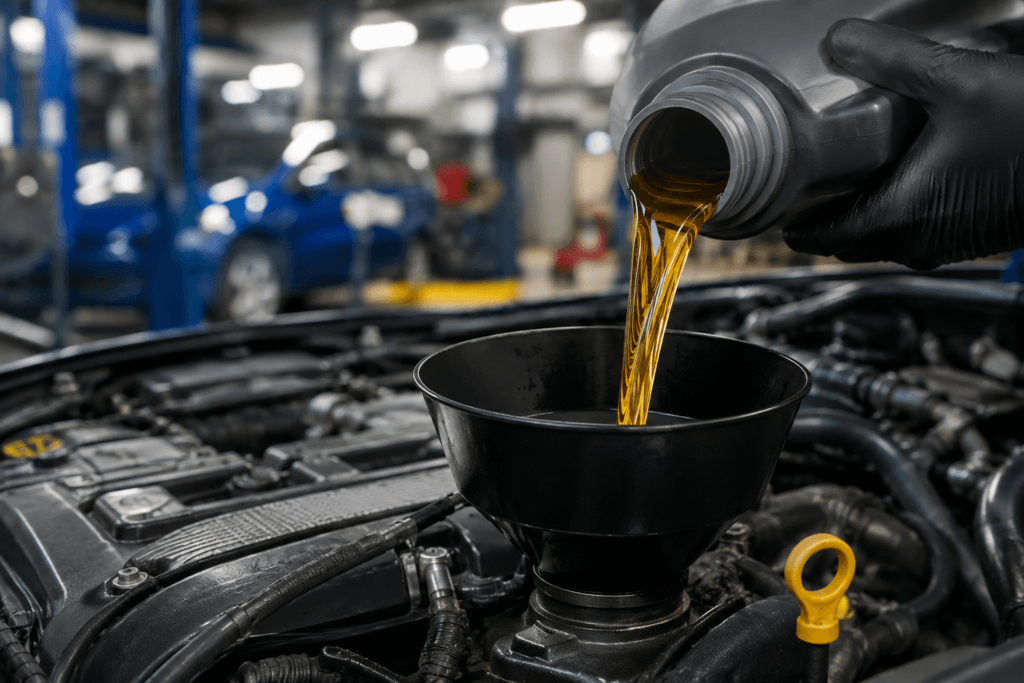
The honest answer is that there is no single oil change schedule that works for every vehicle. Many modern vehicles can travel approximately 8,000 to 16,000 kilometres between oil changes, but the correct interval depends on the manufacturer’s recommendations, the type of oil being used, the vehicle’s age, and how the vehicle is driven.
Your owner’s manual and oil-life monitoring system should always be the starting point. Drivers who make frequent short trips, spend long periods in traffic, tow heavy loads, or operate their vehicles in extreme temperatures may need oil changes sooner than drivers who regularly travel longer distances under moderate conditions.
Why the Traditional 5,000-Kilometre Rule Does Not Apply to Every Vehicle
For many years, drivers were told to change their engine oil every 5,000 kilometres or every three months. That recommendation was useful for older engines and conventional motor oils, but vehicle and oil technology have improved considerably.
Modern engines are built with more precise tolerances, and today’s motor oils are designed to resist heat, contamination, and breakdown for longer periods. As a result, many newer vehicles have manufacturer-recommended intervals that are considerably longer than 5,000 kilometres.
However, this does not mean every vehicle should automatically follow an extended schedule. Older engines, turbocharged engines, high-mileage vehicles, and vehicles operated under demanding conditions may still benefit from shorter intervals.
Your Owner’s Manual Provides the Most Reliable Oil Change Interval
The manufacturer designed and tested your engine, which makes the maintenance schedule in your owner’s manual the most reliable source for determining how often the oil should be changed.
The manual may provide two different schedules: one for normal driving and another for severe driving. Many drivers are surprised to learn that their daily routine may qualify as severe service even when they do not drive aggressively.
Severe service can include frequent trips of only a few kilometres, extended idling, repeated stop-and-go traffic, towing, carrying heavy loads, driving on dusty roads, or regularly operating in very hot or cold conditions.
If you are uncertain which schedule applies to your driving habits, a technician performing an oil change in Delta can help you choose an appropriate interval based on your vehicle, mileage, oil type, and typical use.
How Many Kilometres Can You Drive Between Oil Changes?
Many late-model vehicles using the manufacturer-approved oil can travel approximately 8,000 to 16,000 kilometres between oil changes. Some vehicles may recommend shorter intervals, while others may permit longer intervals under ideal operating conditions.
The number printed on an oil bottle should not replace the vehicle manufacturer’s recommendation. Even when an oil is advertised as offering extended protection, the engine’s filtration system, oil capacity, operating temperature, and design still determine the appropriate maintenance interval.
A practical approach is to follow the mileage or time limit listed by the manufacturer, whichever comes first. A vehicle that is driven only occasionally may reach its time limit long before it reaches the recommended kilometres.
Why Time Matters Even When You Do Not Drive Very Much
Low annual mileage does not eliminate the need for regular oil changes. Engine oil can collect moisture, fuel residue, acids, and combustion contaminants over time.
Short trips can make this problem worse because the engine may not remain at full operating temperature long enough to evaporate accumulated moisture. A vehicle used mainly for quick errands around Delta may therefore need service based on time rather than mileage.
For many vehicles, this means changing the oil at least once every six to twelve months, even when the recommended kilometre limit has not been reached. The exact time requirement should still be confirmed in the owner’s manual.
Does Synthetic Oil Allow You to Wait Longer?
Synthetic oil generally performs better than conventional oil under high temperatures, cold starts, and demanding operating conditions. It also tends to resist oxidation and viscosity breakdown for longer periods.
That does not mean synthetic oil allows every vehicle to follow an unlimited or automatically extended interval. The correct schedule still depends on the manufacturer’s requirements.
Some engines are designed specifically for synthetic oil and longer service intervals. Other vehicles may use synthetic oil while still requiring more frequent changes because of their engine design, driving conditions, or maintenance schedule.
Using synthetic oil can provide valuable protection, but it should be viewed as a better-performing lubricant rather than permission to ignore the recommended service interval.
How an Oil-Life Monitoring System Determines When Service Is Due
Many newer vehicles use an oil-life monitoring system instead of relying on a fixed mileage reminder. These systems generally estimate oil condition by analyzing factors such as engine temperature, operating time, vehicle speed, trip length, engine load, and the number of cold starts.
An oil-life monitor does not usually test the oil directly. It calculates how quickly the oil is likely to deteriorate based on how the vehicle has been operated.
This makes the system more useful than a simple kilometre counter, but it must be reset correctly after every oil change. If it is not reset, the reading will no longer match the condition of the oil currently in the engine.
Drivers should arrange service when the monitor indicates that oil life is low rather than continuing to drive far beyond the reminder.
When Should You Use a Shorter Oil Change Interval?
A shorter interval may be appropriate when the vehicle is regularly exposed to conditions that place additional stress on the engine oil.
Frequent short-distance driving is one of the most common reasons. Stop-and-go traffic, long periods of idling, commercial use, towing, mountain driving, and repeated cold starts can also accelerate oil contamination and breakdown.
This is particularly relevant in the Lower Mainland, where a vehicle may spend considerable time idling or moving slowly in traffic despite covering relatively few kilometres.
A shorter schedule may also be recommended for older vehicles, engines that consume oil, turbocharged vehicles, or vehicles with an incomplete maintenance history. The interval should be based on actual operating conditions rather than mileage alone.
Warning Signs That an Oil Change May Be Overdue
The safest approach is to change the oil before symptoms appear. However, several warning signs may indicate that the oil has been in service too long.
An illuminated oil-change reminder is the clearest sign. Other possible indicators include dark or heavily contaminated oil, increased engine noise, reduced smoothness, a noticeable oil smell, or an oil level that continues to drop.
Dark oil alone does not always mean the oil has failed because modern oil is designed to collect contaminants as it circulates. Its colour should be considered together with the mileage, service date, oil level, and manufacturer’s recommended interval.
An oil-pressure warning light requires immediate attention. It may indicate low oil pressure rather than a routine maintenance reminder. Continuing to drive with low oil pressure can cause serious engine damage.
What Happens When Oil Changes Are Delayed?
Engine oil lubricates moving components, reduces friction, carries heat away from critical areas, and holds contaminants in suspension until they can be captured by the oil filter.
As the oil ages, its protective additives become depleted and contamination increases. The oil may thicken, thin out, or form sludge depending on the engine and operating conditions.
Delayed oil changes can contribute to accelerated wear, restricted oil passages, reduced efficiency, increased oil consumption, and internal engine deposits. In severe cases, inadequate lubrication can damage bearings, timing components, turbochargers, or other expensive engine parts.
Extending an oil change slightly beyond the recommended interval may not cause immediate failure, but repeatedly delaying service increases unnecessary risk.
Can You Change Your Oil Too Often?
Changing engine oil earlier than required is unlikely to harm the engine when the correct oil and filter are used. However, excessively frequent oil changes can increase maintenance costs and create unnecessary waste without providing meaningful additional protection.
For example, a modern vehicle with a manufacturer-approved 12,000-kilometre interval usually does not need oil changes every 3,000 kilometres under normal driving conditions.
The goal is not to wait as long as possible or to change the oil as frequently as possible. The goal is to select an interval that matches the vehicle’s specifications and actual operating conditions.
Should the Oil Filter Be Replaced Every Time?
In most cases, the oil filter should be replaced during every oil change. The filter captures dirt, metal particles, carbon residue, and other contaminants circulating through the lubrication system.
Reusing an old filter can reduce the benefit of adding fresh oil. A heavily restricted filter may also allow unfiltered oil to bypass the filter media, depending on the filter and engine design.
The replacement filter should meet the manufacturer’s specifications. A low-quality or incorrect filter may not provide the required filtration, flow rate, pressure control, or capacity for the full service interval.
How Often Should You Check the Oil Level Between Services?
Even when the oil is changed on schedule, the level should be checked regularly. Some engines naturally consume a small amount of oil, and consumption can increase as a vehicle accumulates kilometres.
Checking the dipstick approximately once a month and before a long trip is a useful habit. Vehicles known to consume oil should be checked more frequently.
An engine can be overdue for added oil without being due for a complete oil change. Topping up the level protects the engine, but it does not replace an oil change because the older oil and accumulated contaminants remain inside the engine.
Always use the oil grade and specification listed by the manufacturer when adding oil.
How to Choose the Right Schedule for Your Vehicle
Start with the maintenance schedule in the owner’s manual. Confirm whether your driving habits fall under normal or severe service, and check whether the manufacturer uses a fixed interval or an oil-life monitoring system.
Next, consider how the vehicle is actually used. A commuter travelling longer distances at steady speeds may be able to follow the normal schedule. A vehicle used mainly for short trips, heavy traffic, towing, delivery work, or repeated idling may need a shorter interval.
Keep a record of the service date, kilometres, oil specification, and filter used. Consistent maintenance records make it easier to follow the correct schedule and may support warranty coverage, resale value, and future diagnostic work.
Is It Safe to Rely Only on the Dashboard Reminder?
A properly functioning oil-life monitor is a useful guide, but drivers should not ignore the oil level or other warning lights while waiting for the maintenance reminder.
The system may estimate oil life, but it cannot prevent an oil leak, detect every case of excessive oil consumption, or confirm that the correct oil was installed during the previous service.
Use the reminder together with regular oil-level checks, maintenance records, and the manufacturer’s time limit. If the vehicle has been sitting for an extended period, the oil may still be due based on time even when the dashboard shows remaining oil life.
The Bottom Line: Follow the Vehicle, Not a Universal Rule
Your vehicle does not automatically need an oil change every 5,000 kilometres, but it should not be pushed beyond the manufacturer’s recommended interval either.
For many modern vehicles, the appropriate schedule falls somewhere between approximately 8,000 and 16,000 kilometres or six to twelve months. Vehicles exposed to short trips, extended idling, towing, heavy traffic, extreme temperatures, or other severe conditions may need service sooner.
The most dependable schedule combines the owner’s manual, the oil-life monitor, regular oil-level checks, and an honest assessment of how the vehicle is driven.
Blue Wrench Auto provides professional oil change service for drivers in Delta and throughout the Lower Mainland. To have your vehicle’s oil, filter, fluid levels, and recommended service interval properly assessed, book an appointment with Blue Wrench Auto.