
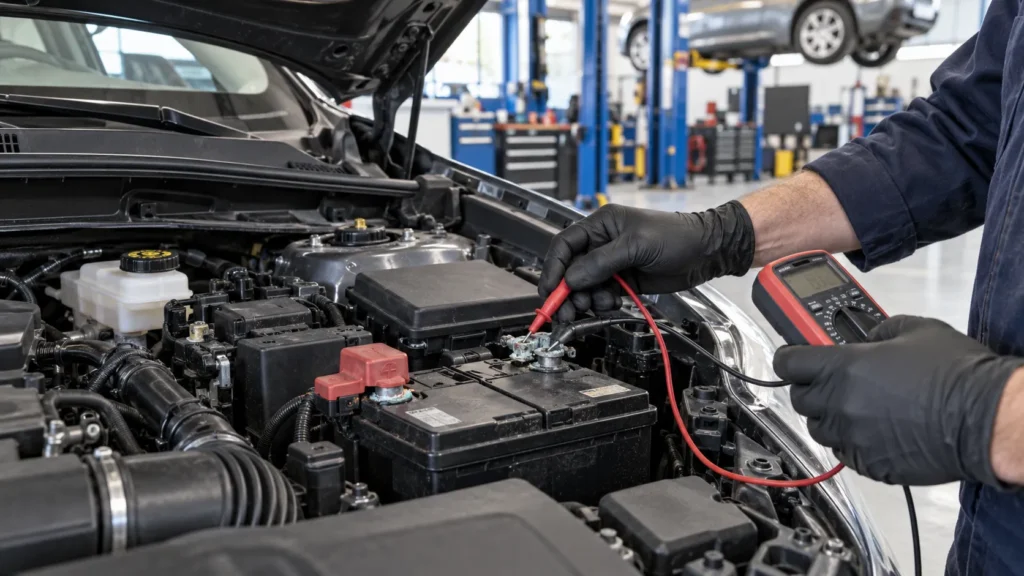
A car battery rarely fails at a convenient time. In many cases, though, there are warning signs before it becomes too weak to start your vehicle. Slow cranking, dim lights, electrical problems, warning lights, corrosion, unusual smells, and battery age can all point to a battery that’s nearing the end of its life.
Recognizing these signs early gives you time to have the battery and charging system tested before you end up with a vehicle that won’t start.
1. The Engine Takes Longer to Start
One of the most common signs of a weakening battery is an engine that turns over more slowly than usual. When you turn the key or press the start button, the battery sends a large amount of electrical power to the starter motor.
As the battery loses strength, it may struggle to provide enough power quickly. You might hear the engine turning over more slowly or notice that it takes an extra second or two before the engine starts.
A slow start doesn’t always mean the battery itself is bad. Starter problems, charging issues, poor electrical connections, and cold temperatures can cause similar symptoms. But if your vehicle is consistently taking longer to start, it’s worth having the system checked.
Blue Wrench Auto provides professional battery service in Delta to help determine whether the battery is weakening or another part of the starting and charging system is responsible.
2. Your Headlights or Interior Lights Look Dimmer
A weakening battery can sometimes cause headlights, interior lights, or dashboard illumination to appear dimmer than normal, especially before the engine is started.
You may also notice lights brighten once the engine starts. Small changes can be normal on some vehicles, but obvious or repeated changes in brightness can point to an electrical supply problem.
The battery isn’t always the cause. Once the engine is running, the alternator provides much of the vehicle’s electrical power. That’s why proper testing is important before replacing anything.
3. Electrical Features Start Acting Strangely
Modern vehicles rely heavily on stable electrical voltage. When a battery starts losing capacity, some electronic systems may behave inconsistently.
You might notice power windows moving slower than usual, the infotainment system restarting, dashboard displays flickering, memory settings resetting, or other electrical features working differently.
These symptoms can be especially noticeable immediately after starting the vehicle because that’s when the battery has just used a large amount of its available power.
Electrical issues can have many causes, so symptoms alone shouldn’t be used to decide that a battery needs replacement. Testing the battery under load can show whether it can still provide the power your vehicle requires.
4. The Battery Warning Light Comes On
The battery-shaped warning light on your dashboard doesn’t always mean the battery itself has failed.
In many vehicles, this warning is connected to the charging system. It can indicate that the battery isn’t being properly recharged while the engine is running.
Possible causes can include the alternator, wiring, electrical connections, charging components, or the battery itself.
If the battery warning light remains on while you’re driving, don’t ignore it. If the charging system isn’t working properly, the vehicle may continue operating only until the remaining power stored in the battery is used up.
5. You Notice Corrosion Around the Battery Terminals
Take a look at the battery terminals occasionally. White, blue, or greenish buildup around the terminals can be a sign of corrosion.
Corrosion can interfere with the electrical connection between the battery and the vehicle. Even a battery that’s still capable of holding a charge may have difficulty delivering power through heavily corroded or loose connections.
That can lead to slow starting, intermittent electrical problems, or charging issues.
Minor corrosion can often be cleaned, but heavy or recurring buildup should be inspected. If the battery appears damaged, leaking, cracked, or swollen, avoid handling it yourself.
6. There’s a Rotten-Egg Smell Near the Battery
A strong sulphur-like or rotten-egg smell around the battery isn’t normal.
It can indicate that the battery is leaking, overheating, being overcharged, or experiencing an internal failure.
If you notice this smell, especially together with a swollen battery case, excessive heat, or visible leaking, don’t continue handling the battery. Automotive batteries contain corrosive materials and can produce gases that need to be treated carefully.
The charging system should also be checked because overcharging from another component can sometimes damage the battery.
7. Your Battery Is Several Years Old
Battery age matters.
Car batteries gradually lose their ability to store and deliver electrical energy. How quickly that happens depends on the battery, driving habits, vehicle electronics, temperature, and how frequently the vehicle is driven.
Frequent short trips can be harder on a battery because the engine repeatedly uses battery power to start without always giving the charging system enough driving time to fully replace that energy.
Colder temperatures can also expose a battery that’s already becoming weak. A battery that seemed fine through the summer may suddenly struggle during a colder Lower Mainland morning.
Age alone doesn’t mean a battery needs to be replaced, but an older battery combined with slower starting or electrical symptoms is a good reason to have it tested.
Can a Car Battery Fail Without Warning?
Yes. Some batteries show obvious symptoms for weeks or months, while others can develop an internal problem with very little warning.
A vehicle that started normally yesterday can still have trouble starting tomorrow.
That’s why battery testing is useful once the battery becomes older or whenever you notice a change in how the vehicle starts. Testing can often identify reduced battery capacity before it becomes a complete no-start situation.
Does Needing a Boost Mean Your Battery Is Bad?
Not necessarily.
A battery can become discharged because headlights were left on, the vehicle wasn’t driven for a long period, an electrical component continued drawing power while the vehicle was parked, or the charging system isn’t working properly.
A boost only provides enough outside power to help start the vehicle. It doesn’t tell you why the battery became discharged.
If your vehicle repeatedly needs a boost, the battery and charging system should be tested. Replacing the battery without identifying the cause could leave you with the same problem again.
How Can You Reduce the Chance of an Unexpected Battery Failure?
Pay attention to changes in how your vehicle starts. Slow cranking that keeps getting worse shouldn’t be ignored.
It’s also a good idea to keep the battery securely mounted and make sure the terminals and cable connections remain clean and tight.
If your vehicle isn’t driven very often, repeated short trips may not allow the battery enough time to recover the energy used during startup. Longer drives can sometimes help maintain charge more effectively.
And as your battery gets older, testing becomes increasingly useful. Knowing that the battery is becoming weak gives you the opportunity to replace it on your schedule instead of after the vehicle refuses to start.
Have Your Battery Checked Before It Leaves You Stranded
If you’ve noticed slow starting, dim lights, unusual electrical behaviour, corrosion, charging warnings, or another sign that your battery may be weakening, having it tested can help identify the problem early.
Blue Wrench Auto can inspect the battery and related charging components to determine whether the battery is actually failing or another electrical issue is causing the symptoms.
If the problem isn’t immediately obvious, professional automotive electrical diagnostics can help identify what’s happening without replacing parts unnecessarily.
If your vehicle has become harder to start or you’re concerned about the condition of your battery, book a service with Blue Wrench Auto before a weak battery turns into a no-start situation.